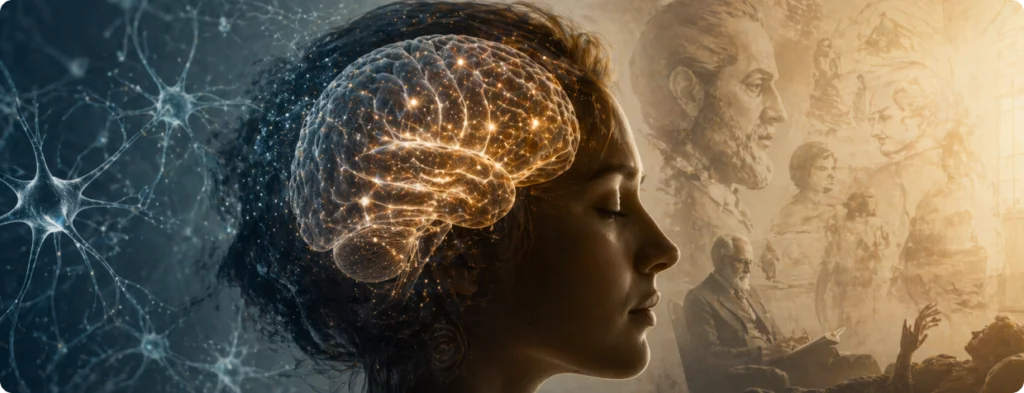
The collaboration between neurology, psychology, and psychoanalysis can be integrated into a field called Neuropsychoanalysis, which bridges the connection between neuroscience (the study of the brain), psychology (the study of mind and behaviour), and psychoanalysis (the unconscious processes) to explain the subjective reality of emotions for the study of mental health and psychopathology (Salone et al., 2016).
Evidence-based research also shows that there can be a coalition of both neurosciences and psychoanalysis to understand the mechanisms responsible for higher brain functions. Salone and her colleagues further explain that neuropsychoanalysis has its core roots in evolutionary aspects, wherein it helps understand psychodynamic concepts of ego, defense mechanisms, and interpretation of dreams (Sigmund Freud, 1899). It also helps deepen the understanding of trauma, attachment patterns, concept of self, and empathy (Salone et al., 2016; Luciani et al., 2014; Panskeep, 2011).
Research also states that there are different patterns and brain areas responsible for representation of self and representation of others (Salone et al., 2016; Molnar-Szakacs & Uddin, 2013). A number of studies showed that healthy subjects were given self-related tasks and other subjects were given other-related tasks (Salone et al., 2016; Li et al., 2014). It was further demonstrated that during self-related tasks, the pregenual anterior cingulate cortex was activated, while the posterior cingulate cortex was activated during others-related tasks. This shows a heightened connectivity between the ventromedial prefrontal cortex and orbitofrontal cortex for self and others representations. Thus, the synergy between self and others can be observed to be disrupted in disorders like schizophrenia, borderline personality disorder, and others (Salone et al., 2016; Molnar-Szakacs & Uddin, 2013; Li et al., 2014; van Veluw & Chance, 2014).
Bridging Neurology and Psychology
The integration between neurology and psychology has been intriguing as well. It shows how several neurological disorders can lead to psychological disturbances and how psychological precipitating factors can lead to long-term neurological impairments. For example, patients with Alzheimer’s dementia can show signs of irritability, temper tantrums, and other behavioural disturbances. Similarly, severe stress can lead to seizures, or depression can lead to cognitive impairments such as deficits in memory and concentration. All these can also lead to functional disturbances in processing the unconscious, subconscious, and conscious, eventually affecting the self.
Neuropsychology connects a person’s cognition and behaviour with the brain and the rest of the nervous system. This branch studies how brain injuries and illnesses can impact affective, behavioural, and cognitive functions. This field also researches animal behaviour through lesion studies (Gluck et al., 2016; Posner & DiGirolamo, 2000).
History of Neuropsychology
- Hippocrates described the brain as the seat of the soul (Finger, 2000).
- Franz Joseph Gall further associated an individual’s personality with features and structures of the brain and skull, which he termed phrenology (Benton, 2000).
- Paul Broca, Carl Wernicke, and Korbinian Brodmann were eminent key figures in neurology who defined brain structures and areas, including Broca’s area, Wernicke’s area, and the 52 Brodmann areas (Cubelli & Bastiani, 2011; Wernicke, 1873; Guillery, 2000).
- Bruce (1985) was the first to bring the term “neuropsychology” back to 1913 in a paper written by Sir William Osler (Dr. Jessica Fish, personal communication, PowerPoint slides, 2023).
- Neuropsychology has been associated with other fields such as neurology, physiology, neuroscience, cognitive psychology, computer science, and clinical psychology.
- Much of the research in neuropsychology emerged after the accident of Phineas Gage in 1848, who survived a penetrating injury to his frontal lobe.
Different Approaches in Neuropsychology
1. Clinical Neuropsychology
Clinical neuropsychology applies neuropsychological understanding to the diagnosis, assessment, and rehabilitation of individuals with brain illness or injury resulting in neurocognitive issues. It also incorporates psychological perspectives to understand how emotional factors interact with illness and injury (UKessays).
For example, if two clients are unable to name items from a list they read earlier, but one improves when given cues, this may indicate vascular dementia rather than Alzheimer’s disease (Cohen, 2008). This distinction highlights differences in brain structures and cognitive manifestations.
2. Cognitive Neuropsychology
Cognitive neuropsychology studies the cognitive processes underlying neurological illnesses. One model is functional localisation (Stebbins, 2007). Another is dissociation, including single and double dissociation models (Jones, 1983; Young et al., 2000).
Teuber’s (1955) double dissociation model demonstrated stronger evidence for structure–function independence by comparing multiple clinical samples. Cognitive neuropsychology therefore focuses on lost cognitive functions linked to specific brain areas and how these functions may be restored.
Neuropsychology and Psychopathology
Neuropsychological disorders include dementia, Alzheimer’s disease, Parkinson’s disease, Huntington’s disease, ADHD, schizophrenia, and others. These conditions impair cognition, memory, attention, and executive functions, and can cause emotional and social distress. Early detection and intervention are crucial (Journal of Psychological Disorders).
Acquired and Traumatic Brain Injuries (ABI & TBI)
Alcohol-related brain damage (ARBD) involves intoxication, thiamine deficiency, and metabolic disturbances (Kopelman et al., 2009). Severe alcohol use can lead to Wernicke’s encephalopathy and Korsakoff syndrome, characterized by amnesia, confabulation, and executive dysfunction (Svanberg & Evans, 2013).
Encephalitis
Encephalitis refers to inflammation of the brain caused by infection or autoimmune processes (Alam et al., 2022). Symptoms range from physiological to cognitive and behavioural changes.
Main forms of encephalitis include infectious, post-infectious, autoimmune (e.g., NMDA receptor), and sub-acute encephalitis (Easton, personal communication, 2024).
Consequences include cognitive deficits, emotional changes, and physiological impairments that affect daily functioning (Encephalitis International, 2023).
Confabulation
Confabulation involves spontaneous false memories without intent to deceive (Kopelman, 2015). Forms include provoked, momentary, fantastic, and behaviourally spontaneous confabulations (Nahum et al., 2012).
Epilepsy & Seizures
Epilepsy is a persistent neurological disorder characterized by recurrent seizures (Baker & Jacoby, 2001). The ILAE defines epilepsy based on seizure patterns, recurrence risk, or epilepsy syndromes (Fisher et al., 2014).
Epilepsy has long-term psychosocial consequences affecting education, employment, relationships, and mental health (Chin et al., 2011; Camfield & Camfield, 2007).
Degenerative Conditions
Vascular Dementia (VD) & Alzheimer’s Disease (AD)
VD often presents with deficits in attention and processing speed, whereas AD begins with episodic memory impairment. Cognitive profiles differ in encoding versus retrieval deficits (Graham et al., 2004).
Stroke
Stroke results from blocked or ruptured blood vessels in the brain and can cause aphasia, apraxia, prosopagnosia, acalculia, and spatial disorientation (Le & Lui, 2023; Rothi & Heilman, 1984).
Neuropsychological Rehabilitation
Neuropsychological rehabilitation focuses on restoring and compensating cognitive, emotional, behavioural, and social impairments using structured assessments and interventions, leveraging neuroplasticity (London Neurocognitive Clinic, 2025).
Neuropsychology and Its Future
Neuropsychology has evolved into a highly empirical field with evidence-based rehabilitation approaches. Its future lies in integrating neurological and psychological perspectives to enhance adaptive functioning and overall well-being (Casaletto & Heaton, 2018).


